An initiative by the NCCF designed to inform and encourage active participation within the nuclear community.
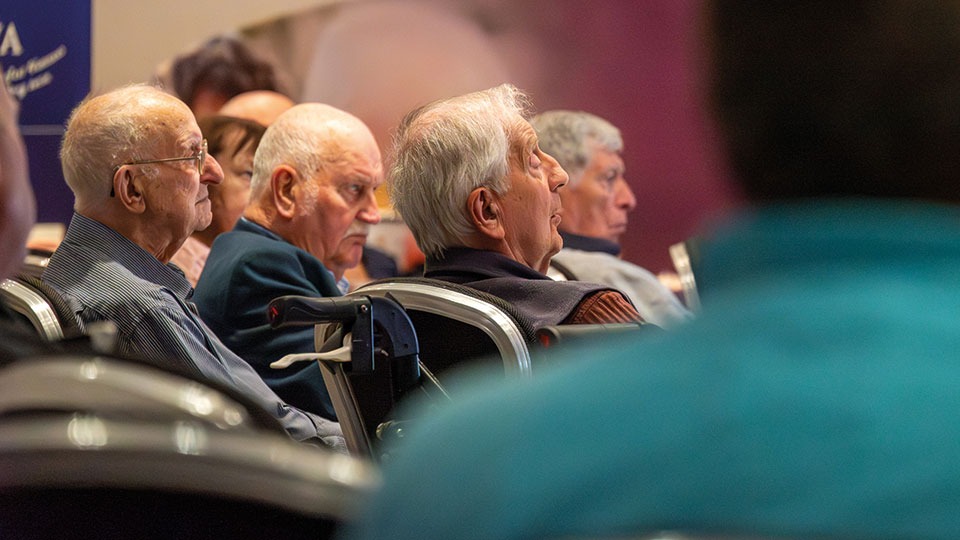
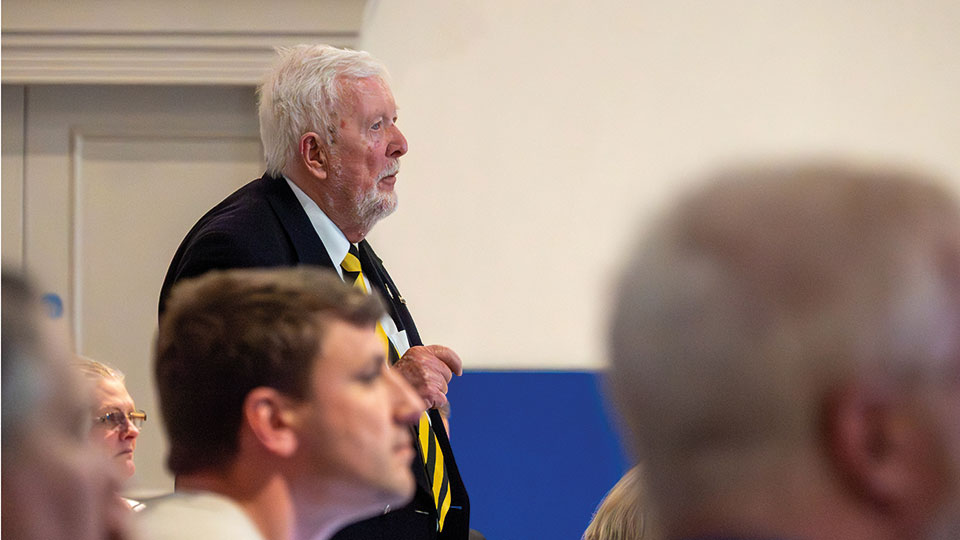
It was a landmark moment at the 2026 Nuclear Community Convention when Nigel Heaps MBE took to the podium to deliver what he described as the most “ambitious and consequential development” the community had seen. Speaking with evident conviction and with full awareness, as he noted, of everything the community has been through together. Nigel announced that the Nuclear Community Charity Fund (NCCF) was officially launching the Nuclear Community Lived Experience Network: the NCLEN.
Before outlining what the NCLEN is, Nigel was careful to acknowledge where the community stands. The picture, he said, is genuinely encouraging. The Centre for Health Effects of Radiological and Chemical Agents (CHRC) at Brunel University offers world-class research, translated into accessible lay summaries. The NCCF, Labrats, and the BNTVA Museum each hold distinct and vital ground. The Liverpool-based Nuclear Justice Project and the Cold War Network add further breadth. Three separate key entities, capable of addressing almost every dimension of community need.
Yet he was clear: complacency is not an option. Veterans are being lost at an increasing rate. And in a moment that brought the challenge into sharp relief, the most recent NCCF Trustee Board meeting was convened for the first time with no veterans among its members. That, he said, is a bellwether, and it demands a response.
Moving Beyond “Doing For”
For decades, the nuclear community has been the subject of research and service delivery that, as Nigel put it, often “did to” or “did for” veterans rather than working alongside them. The NCLEN marks a fundamental shift toward co-production, a model described as the meeting of “Head, Heart, and Hands,” in which professionals and those with lived experience work as genuine equals from the very start of a project to its very finish. This change aims to inspire trust in a more inclusive future.
“Our mandate is now ‘doing with’ and ‘alongside,’” he told delegates. “The LEN acts as a strategic bridge, ensuring that your actual experiences inform every decision the charities and other organisations make. We aren’t here for a win-lose debate. We are here for a meeting of minds.”
Managed by the NCCF, the NCLEN will be accessible to all organisations operating for the benefit of our nuclear survivor community, inviting stakeholders to engage directly with beneficiaries and help shape future initiatives.
How It Works: One Engagement, Many Purposes
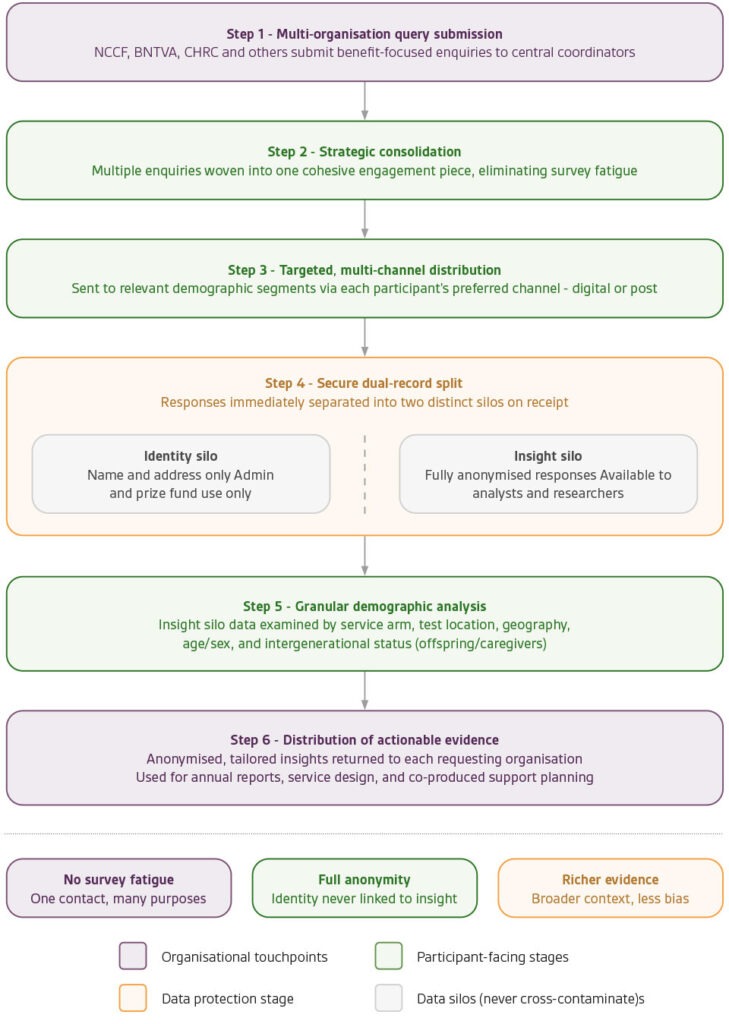
One of the most practically significant aspects of the NCLEN is how it handles data collection, and it is worth understanding this clearly because it directly addresses one of the most common frustrations experienced across the community: being contacted repeatedly by different organisations asking similar questions.
The system is also fully compliant with the legal requirements and safeguards of data capture and processing in the UK.
The NCLEN replaces that fragmented, piecemeal approach with a centralised, integrated system. Rather than each organisation, the NCCF, the BNTVA, the CHRC, and others running their own separate surveys, all enquiries are submitted to the NCLEN’s central coordinators. Those coordinators then weave the various questions together into a single, cohesive engagement piece. One contact. One set of questions. Multiple organisations served simultaneously.
The consolidated engagement is then distributed to the relevant demographic segments, but only to those for whom the questions are genuinely relevant via whichever method each member prefers: a digital survey by mobile or web, or a traditional paper questionnaire by post.
As responses come in, the system immediately separates the data into two completely distinct records. The Identity Silo, which holds your name and contact details, is used solely for administrative purposes, including managing the prize fund. The Insight Silo holds your anonymised responses, entirely decoupled from your identity, available to analysts and researchers but never traceable back to you. The two records never cross.
There is a further benefit to this consolidated approach that is worth highlighting. Because participants are responding to a broader range of questions in a single sitting, drawn from multiple organisations with different areas of focus, the engagement naturally “blurs” the lens through which any one topic is examined. Rather than a narrow, single-issue survey that can inadvertently shape responses through its framing, participants share a wider breadth of lived experience at once. The result is richer, more authentic data, less susceptible to the unconscious biases that can creep into more focused instruments.
Once analysed, broken down by service arm, test location, geography, generational status, and other relevant factors, the insights are returned to each of the original requesting organisations as anonymised, actionable evidence. What began as separate enquiries from multiple charities becomes a single, respectful interaction for the member, and a set of tailored, evidential insights for everyone who asked.
Breaking the Silence on “Exposure Worry”
Underpinning the entire system is a recognition of what the NCCF terms “Exposure Worry”, the persistent anxiety around ionising radiation and its potential multi-generational health legacy that many veterans and their families carry every day. The dual-record architecture described above is not merely an administrative convenience. It is a direct response to the fear of professional or social stigma that has too often kept people silent.
By decoupling who you are from what you share, the system is designed to produce “unvarnished data”: honest, unfiltered insight from the people whose lives and health are at stake. You can speak freely. Your name is never attached to what you say.
One Community, Many Experiences
The NCLEN is built on a recognition that the “nuclear community” is not one single group. It is veterans from different service arms who attended different tests under vastly different conditions. It is their spouses and widows carrying the burden of caring. It is their children who carry health anxieties across generations. It is caregivers and family supporters, often quietly managing what the NCCF terms “secondary trauma” and caregiver burnout, with little recognition of their own.
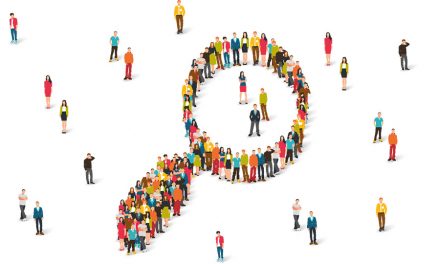
Targeted segmentation through demographic analysis allows organisations using the network to ask the right questions of the right people, identifying radiological risk profiles by service arm and test attended; mapping the logistical barriers faced by those in remote coastal communities far from support services; and capturing the specific concerns of offspring and supporters alongside those of the veterans themselves.
Targeted segmentation allows the network to identify radiological risk profiles by service arm and test attended; to map the logistical barriers faced by those in remote coastal communities far from support services; and to capture the specific concerns of offspring and supporters alongside those of the veterans themselves. The granular demographic analysis that follows ensures that the insights returned to organisations are genuinely specific, not broad generalisations, but evidence shaped by the real diversity of experience within the community.
Ethically Recognising Contribution
The NCLEN also introduces what it calls Ethical Incentivisation, an acknowledgement that sharing your story takes time, emotional energy, and often real courage.
Every organisation engaged in asking questions or surveying responses through each turn of the LEN cycle shall make a £100 total prize fund, distributed across multiple awards (a first prize of £40, two second prizes of £20, and two third prizes of £10) to increase the likelihood that more people benefit from taking part. It is not a bribe. It is a validation of expertise.
A Trauma-Informed Framework
The NCLEN team are under no illusions about the weight of history that accompanies any conversation about nuclear test service. All questions submitted through the network are screened for potential triggers, with well-being signposting built in as standard. Plain English is used throughout, no jargon, no bureaucratic language that risks excluding or confusing the very people the network exists to serve. This approach aims to make participants feel respected and confident in the system’s safety and inclusiveness.
As Nigel put it: “Safeguarding is not a barrier. It is a facilitator. When participants feel safe and respected, they share the qualitative insights that are necessary for change.”
The Engine of Our Future
With the NCLEN now launched, the NCCF is committing to what it describes as a System Maturity Framework, integrating leadership and governance, data and insight, and co-production and support to move the nuclear community toward services that are genuinely co-created rather than simply delivered and what is more by opening the system to the wider organisations servicing our nuclear community we are increasing the quality, service provision and experience of our beneficiaries.
For an ageing community whose voices have too often gone unheard, it is, as Nigel concluded, the “engine of our future”, a commitment to ensuring that lived experience is not just acknowledged, but sits at the very heart of every decision made on behalf of the people who have given so much, and for so long.
NCLEN System Workthrough